Sosialisasi Karakteristik dan Deteksi Dini Anak Berkebutuhan Khusus di Sekolah Inklusi
DOI:
https://doi.org/10.64850/kareba.v1i2.85Keywords:
Anak Berkebutuhan Khusus, Deteksi Dini, Identifikasi ABK, Pendidikan Inklusif, Sosialisasi GuruAbstract
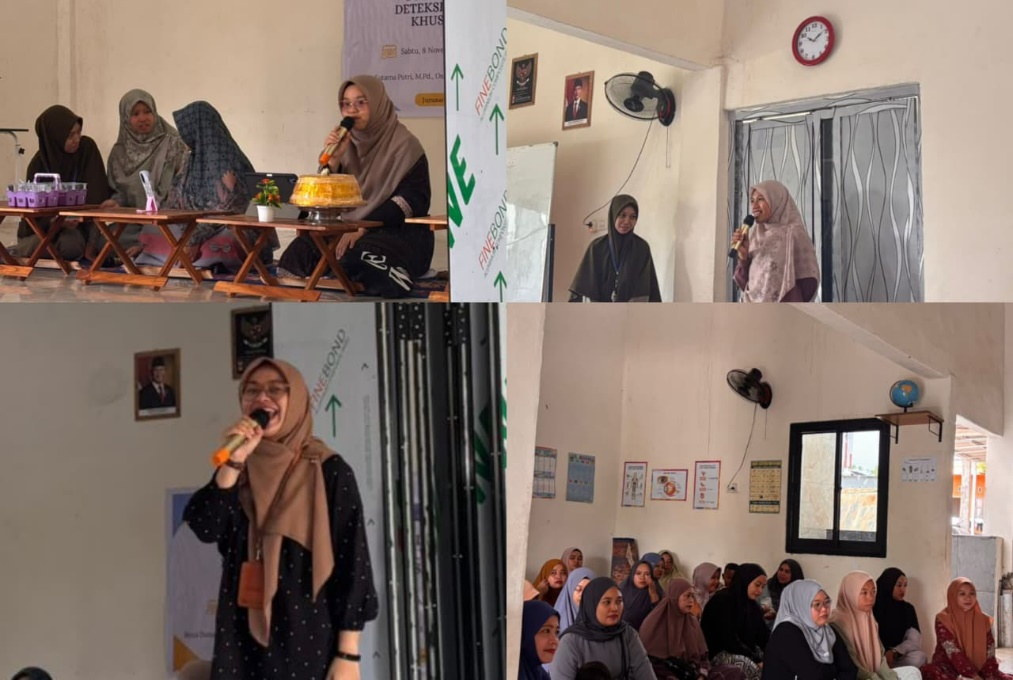
Pendidikan inklusif menghadapi tantangan signifikan terkait kemampuan guru dalam mengidentifikasi Anak Berkebutuhan Khusus (ABK) di kelas reguler. Kegiatan pengabdian kepada masyarakat ini bertujuan untuk meningkatkan pengetahuan dan keterampilan guru dalam mengidentifikasi karakteristik dan melakukan deteksi dini ABK di sekolah inklusi. Metode pelaksanaan terdiri dari tiga tahapan: persiapan, sosialisasi, dan evaluasi. Kegiatan sosialisasi dilaksanakan pada 8 November 2025 di SDIT Kuttab Al Hasan, Kabupaten Gowa, Sulawesi Selatan dengan melibatkan 15 guru sebagai peserta. Materi sosialisasi mencakup konsep identifikasi ABK dan instrumen deteksi dini yang dapat langsung diaplikasikan. Hasil evaluasi menunjukkan peningkatan pemahaman yang signifikan dari rata-rata 2,80 sebelum kegiatan menjadi 3,93 setelah kegiatan (peningkatan 40,4%). Manfaat utama yang diperoleh peserta meliputi pengetahuan baru tentang karakteristik ABK (80%), peningkatan motivasi untuk peduli pada ABK (80%), dan instrumen praktis yang dapat langsung digunakan (73,3%). Kegiatan ini berhasil meningkatkan kompetensi guru dalam identifikasi ABK dan memberikan kontribusi nyata bagi implementasi pendidikan inklusif yang lebih efektif di sekolah mitra.
Downloads
References
Depdiknas. (2009). Permendiknas No. 70 Tahun 2009 tentang Pendidikan Inklusif bagi Peserta Didik yang Memiliki Kelainan dan Memiliki Potensi Kecerdasan dan/atau Bakat Istimewa. Departemen Pendidikan Nasional.
Heward, W. L. (2013). Exceptional Children: An Introduction to special Education 10th Education. Pearson.
Irman, O., & Mustafa, I. (2025). Penyuluhan dengan Pendekatan Komunikasi Persuasif untuk Pengendalian Faktor Risiko Sindrom Koroner Akut pada Penderita Diabetes Melitus. 1(1), 1–7.
Kauffman, J. M., & Hallahan, D. P. (2011). Handbook of Special Education. In Routledge. Routledge. https://doi.org/10.4324/9780203837306
Kirk, S., Gallagher, J. J., Coleman, M. R., & Anastasiow, N. (2009). Educating Exceptional Children. Houghton Miffl in Harcourt Publishing Company.
McLoughlin, J., Kritikos, E., & Lewis, R. (2018). Assessing Students with Special Needs, with Enhanced Pearson EText -- Access Card Package. Pearson Education. https://books.google.co.id/books?id=dAcRMQAACAAJ
Ndoya, M. K., Dhera, M. M., Awu, Y., & Nono, U. (2023). Efektivitas Pelatihan Bagi Guru Untuk Meningkatkan Kemampuan Identifikasi Anak Berkebutuhan Khusus Di Sekolah Inklusi. Jurnal Pendidikan Inklusi Citra Bakti, 1(1), 50–59. https://doi.org/10.38048/jpicb.v1i1.2104
Satwika, Y. W., Khoirunnisa, R. N., Laksmiwati, H., & Jannah, M. (2018). Efektivitas pelatihan identifikasi anak berkebutuhan khusus pada guru sekolah inklusi. PSIKOSAINS (Jurnal Penelitian Dan Pemikiran Psikologi), 13(2), 109–121. https://doi.org/10.30587/psikosains.v13i2.763
Sunardi, S., Yusuf, M., Gunarhadi, Priyono, & & Yeager, J. L. (2011). The Implementation of Inclusive Education for Students with Special Needs in Indonesia. Excellence in Higher Education, 2, 1–10. https://doi.org/10.5195/ehe.2011.27
Tarnoto, N. (2016). Permasalahan-Permasalahan yang Dihadapi Sekolah Penyelenggara Pendidikan Inklusi pada Tingkat SD. Humanitas, 13(1), 50–61. https://doi.org/10.26555/humanitas.v13i1.3843
Wardany, O. F., & Ulfa, D. A. (2022). Kesiapan guru dalam penyelenggaran kelas inklusi di MI NW Lendang Penyonggok, Lombok. Jurnal Pendidikan Khusus (JPK), 18(2), 113–123. https://journal.uny.ac.id/index.php/jpk/article/view/48322
Downloads
Published
Issue
Section
License
Copyright (c) 2025 Reza Sutarna Putri, Ossy Firstanti Wardany, Rini Lestari, Nur Wulandani (Author)

This work is licensed under a Creative Commons Attribution-ShareAlike 4.0 International License.
In submitting the manuscript to the journal, the authors certify that:
- They are authorized by their co-authors to enter into these arrangements.
- The work described has not been formally published before, except in the form of an abstract or as part of a published lecture, review, thesis, or overlay journal.
- That it is not under consideration for publication elsewhere,
- That its publication has been approved by all the author(s) and by the responsible authorities – tacitly or explicitly – of the institutes where the work has been carried out.
- They secure the right to reproduce any material that has already been published or copyrighted elsewhere.
- They agree to the following license and copyright agreement.
License and Copyright Agreement
Authors who publish with Kareba: Jurnal Pengabdian Masyarakat agree to the following terms:
- Authors retain copyright and grant the journal right of first publication with the work simultaneously licensed under Creative Commons Attribution License (CC BY-SA 4.0) that allows others to share the work with an acknowledgment of the work's authorship and initial publication in this journal.
- Authors can enter into separate, additional contractual arrangements for the non-exclusive distribution of the journal's published version of the work (e.g., post it to an institutional repository or publish it in a book), with an acknowledgment of its initial publication in this journal.
- Authors are permitted and encouraged to post their work online (e.g., in institutional repositories or on their website) before and during the submission process, as it can lead to productive exchanges, as well as earlier and greater citation of published work.