Pelatihan Kewirausahaan Pembuatan Sabun Gaharu Gyrinops Bagi Mahasiswa Kebidanan Universitas Bhakti Kencana
DOI:
https://doi.org/10.64850/kareba.v1i2.88Keywords:
Gaharu, Merdeka Belajar, Kewirausahaan, KebidananAbstract
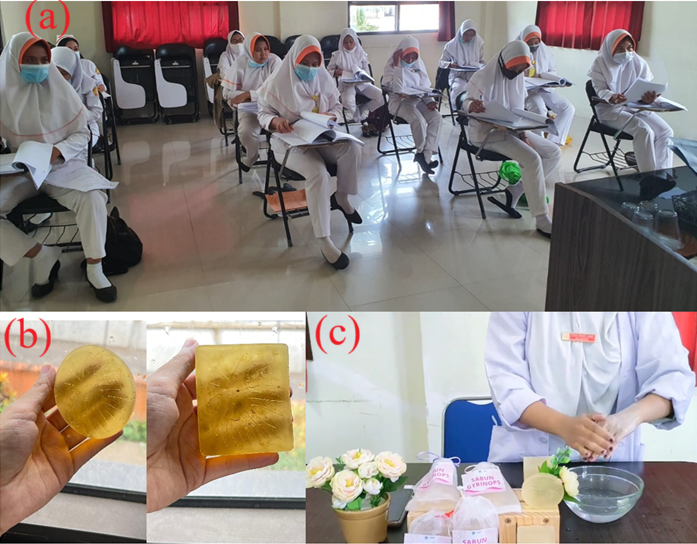
Pelatihan kewirausahaan melalui skema Merdeka Belajar Kampus Merdeka (MBKM) relatif jarang dilakukan di program studi kesehatan, termasuk di program studi kebidanan. Di satu sisi, pelatihan kewirausahaan dengan output produk terapi komplementer dapat menunjang karier saat lulus nanti. Kegiatan pengabdian kepada masyarakat ini bertujuan untuk melakukan pendampingan dan pelatihan kewirausahaan produk kesehatan terapi komplementer sabun gaharu Gyrinops secara holistik kepada mahasiswa kebidanan Universitas Bhakti Kencana. Kegiatan pengabdian ini dilakukan meliputi 3 tahap utama yaitu: tahap teori, tahap praktek dan tahap evaluasi. Evaluasi dilakukan pada partisipan (mahasiswa kebidanan Universitas Bhakti Kencana) dan juga produk sabun gaharu Gyrinops yang dibuat oleh partisipan. Kegiatan ini menghasilkan output sabun gaharu Gyrinops dengan 7 tahap sistematis yang menjadi standar kompetensi partisipan. Partisipan telah memahami metode pembuatan sabun gaharu Gyrinops yang di indikasikan dari prosentase ketercapaian kompetensi paling rendah sebesar 75%. Prosentase ketercapaian tahap praktek sedikit lebih rendah dibandingkan tahap teori menunjukkan adanya sedikit kendala dalam proses aplikasi teori, meskipun tidak signifikan. Evaluasi terhadap sabun gaharu Gyrinops menunjukkan bahwa produk ini memperoleh rerata skor hedonik 7,3 – 7,9 yang menunjukkan level tingkat preferensi yang tinggi. Dapat disimpulkan bahwa kegiatan pengabdian ini berhasil melatih mahasiswa kebidanan Universitas Bhakti Kencana memperoleh kompetensi tambahan untuk membuat produk terapi komplementer sabun gaharu Gyrinops dengan standar mutu yang bagus dan level preferensi yang tinggi.
Downloads
References
Aini, H., Kurnia, N., & Wangiyana, I. G. A. S. (2024). Sensory evaluation of lemongrass beverage mixed with agarwood infusion using 9-point hedonic scale. Jurnal Silva Samalas, 7(2), 28–35. https://doi.org/10.33394/jss.v7i2.14298
Alum, B. N. (2024). Saponification process and soap chemistry. INOSR Applied Science, 12(2), 51–56. https://doi.org/10.59298/INOSRAS/2024/12.2.515600
Andini, I. F., Susanti, E., Esmianti, F., & Febrina, L. (2022). Pembentukan bidan enterpreneur sebagai peluang usaha bidan melalui pelatihan postnatal treatment. RAMBIDEUN: Jurnal Pengabdian Kepada Masyarakat, 5(2), 100–107. https://doi.org/10.51179/pkm.v5i2.915
Arief, F., & Yulleila. (2020). Implementasi keterampilan kewirausahaan sebagai media character building pada era revolusi industri 4.0. Jurnal Bina Ilmu Cendekia, 1(1), 13–23. https://doi.org/10.46838/jbic.v1i1.2
Bainuan, L. D., & Tarigan, Y. Z. (2024). Strategy of the independent learning program-independent campus (MBKM) for the health study program curriculum: Scoping review. Journal of Scientific Research, Education, and Technology, 3(1), 19–31. https://doi.org/10.58526/jsret.v3i1.310
Bhavani, J., Chinnathambi, M., Sandhanam, S., Jothilingam, S., Arthi, S., & Monisha, N. (2023). Formulation and evaluation of herbal soap by using natural ingredient. World Journal of Pharmaceutical Research, 12(6), 669–688.
Calder, B. J., & Tybout, A. M. (2016). What makes a good theory practical? AMS Review, 6(3), 116–124. https://doi.org/10.1007/s13162-016-0084-1
De Silva, S. I. S., Bulathgama, B. E. A. U., Somarathna, K. T. A. G., Ranasingha, R. D. A. K., Karunarathna, K. H. T., Rajawatta, K. M. W., & Chandana, E. P. S. (2024). Physico-chemical and consumer preference analysis of novel herbal soap enriched with aloe vera (aloe barbadensis). Proceedings of Papers, 4th International Conference on Science and Technology, 27–31.
Fatmawati, Z., Sumini, G. T., Anjarsari, W., Suryani, L., & Retnowati, D. (2023). Membangun jiwa kewirausahaan dalam pelayanan kebidanan komplementer “Baby Spa” Di Griya Sehat Bunda Madiun. Prosiding Seminar Nasional Unimus, 1181–1190.
Hamzah, F., Ultri, U., Ayu, D. F., & Pramana, A. (2024). Liquid body wash formulation with the addition of agarwood leaf extract. Industria: Jurnal Teknologi Dan Manajemen Agroindustri, 13(1), 98–114. https://doi.org/10.21776/ub.industria.2024.013.01.7
Hia, L. N., Madhakomala, & Rugaiyah. (2022). Konsep kewirausahaan mahasiswa di era merdeka belajar. Jurnal Pendidikan Intelektium, 3(1), 96–105.
Ismanto, S. D., Neswati, N., & Amanda, S. (2016). Pembuatan sabun padat aromaterapi dari minyak kelapa murni (virgin coconut oil) dengan penambahan minyak gubal gaharu (Aquilaria malaccensis). Jurnal Teknologi Pertanian Andalas, 20(2), 9–18. https://doi.org/10.25077/jtpa.20.2.9-18.2016
López-Sampson, A., & Page, T. (2018). History of use and trade of agarwood. Economic Botany, 72(1), 107–129. https://doi.org/10.1007/s12231-018-9408-4
Putri, Y. S., Wangiyana, I. G. A. S., & Nahlunnisa, H. (2021). Efectiveness of Gyrinops versteegii leaves extraction based on maceration method. Jurnal Silva Samalas, 4(2), 1–8. https://doi.org/10.33394/jss.v4i2.4514
Schmidt, A., Hengelbrock, A., & Strube, J. (2024). Continuous biomanufacturing in upstream and downstream processing. Physical Sciences Reviews, 9(10), 3167–3222. https://doi.org/doi:10.1515/psr-2022-0106
Sulistiyani, E., Khamida, K., Soleha, U., Amalia, R., Hartatik, S., Putra, R. S., Budiarti, R. P. N., & Andini, A. (2022). Implementasi Merdeka Belajar Kampus Merdeka (MBKM) pada Fakultas Kesehatan dan Non Kesehatan. Edukatif: Jurnal Ilmu Pendidikan, 4(1), 686–698. https://doi.org/10.31004/edukatif.v4i1.1943
Triandini, I. G. A. A. H., Anri, Mulyani, Y., Ziska, R., Muhtar, C. A., & Wangiyana, I. G. A. S. (2023). Implementasi konsep merdeka belajar kolaboratif melalui pengolahan tanaman biofarmaka galaktagog di Kota Mataram. SELAPARANG Jurnal Pengabdian Masyarakat Berkemajuan, 7(1), 83–89. https://doi.org/10.31764/jpmb.v7i1.12496
Wangiyana, I. G. A. S. (2019). Medicinal usage of agarwood resin in form of essential oil: a review. Jurnal Silva Samalas, 2(2), 86–90. https://doi.org/10.33394/jss.v2i2.3674
Wangiyana, I. G. A. S. (2020). Medicinal effect review of agarwood leaves from Aquilaria and Gyrinops Genera. Jurnal Silva Samalas, 3(1), 36–43. https://doi.org/10.33394/jss.v3i1.3681
Wangiyana, I. G. A. S., Akram, & Isbulloh, F. (2020). Perbandingan aktivitas antibakteri ekstrak kasar resin dan daun gaharu (Gyrinops versteegii). Jurnal Bioteknologi & Biosains Indonesia, 7(1), 28–36. https://doi.org/10.29122/jbbi.v7i1.3862
Wangiyana, I. G. A. S., Kurnia, N., Triandini, I. G. A. A. H., & Fatihatum, F. (2024). Sensory evaluation of palm sugar candy from Arenga sap water and agarwood leaves infusion using a 9-point hedonic scale. Jurnal Agrotek Ummat, 11(2), 142–155. https://doi.org/10.31764/jau.v11i2.22756.
Wangiyana, I. G. A. S., Kurnia, N., Triandini, I. G. A. A. H., & Lesmana, P. S. W. (2023). Food sensory respondent training for forestry student of Universitas Pendidikan Mandalika using various hedonic scale. Sasambo: Journal of Community Service, 5(4), 827–834. https://doi.org/10.36312/sasambo.v5i4.1567
Wangiyana, I. G. A. S., Triandini, I. G. A. A. H., & Khalid, I. (2025). Application of various statistical approaches for sensory evaluation of seaweed dodol mixed agarwood infusion. Journal of Agritechnology and Food Processing, 5(1), 1–14. https://doi.org/10.31764/ jafp.v5i1.30841
Wardhani, P. S. N., & Nastiti, D. (2023). Implementasi pendidikan kewirausahaan dalam menumbuhkan minat berwirausaha mahasiswa. Prima Magistra: Jurnal Ilmiah Kependidikan, 4(2), 177–191. https://doi.org/10.37478/jpm.v4i2.2622
Wichchukit, S., & O’Mahony, M. (2015). The 9-point hedonic scale and hedonic ranking in food science: Some reappraisals and alternatives. Journal of the Science of Food and Agriculture, 95(11), 2167–2178. https://doi.org/10.1002/jsfa.6993
Wichchukit, S., & O’Mahony, M. (2022). The 9-point hedonic and unstructured line hedonic scales: An alternative analysis with more relevant effect sizes for preference. Food Quality and Preference, 99, 104575. https://doi.org/10.1016/j.foodqual.2022.104575
Downloads
Published
Issue
Section
License
Copyright (c) 2025 I Gde Adi Suryawan Wangiyana, I Gusti Agung Ayu Hari Triandini (Author)

This work is licensed under a Creative Commons Attribution-ShareAlike 4.0 International License.
In submitting the manuscript to the journal, the authors certify that:
- They are authorized by their co-authors to enter into these arrangements.
- The work described has not been formally published before, except in the form of an abstract or as part of a published lecture, review, thesis, or overlay journal.
- That it is not under consideration for publication elsewhere,
- That its publication has been approved by all the author(s) and by the responsible authorities – tacitly or explicitly – of the institutes where the work has been carried out.
- They secure the right to reproduce any material that has already been published or copyrighted elsewhere.
- They agree to the following license and copyright agreement.
License and Copyright Agreement
Authors who publish with Kareba: Jurnal Pengabdian Masyarakat agree to the following terms:
- Authors retain copyright and grant the journal right of first publication with the work simultaneously licensed under Creative Commons Attribution License (CC BY-SA 4.0) that allows others to share the work with an acknowledgment of the work's authorship and initial publication in this journal.
- Authors can enter into separate, additional contractual arrangements for the non-exclusive distribution of the journal's published version of the work (e.g., post it to an institutional repository or publish it in a book), with an acknowledgment of its initial publication in this journal.
- Authors are permitted and encouraged to post their work online (e.g., in institutional repositories or on their website) before and during the submission process, as it can lead to productive exchanges, as well as earlier and greater citation of published work.