Peningkatan Minat Berbahasa Inggris Mahasiswa melalui Program English Star: Studi Pengabdian Masyarakat di Poltekkes Kemenkes Pangkalpinang
DOI:
https://doi.org/10.64850/kareba.v1i2.93Keywords:
English Star, Minat Berbahasa Inggris, Kompetisi EdukatifAbstract
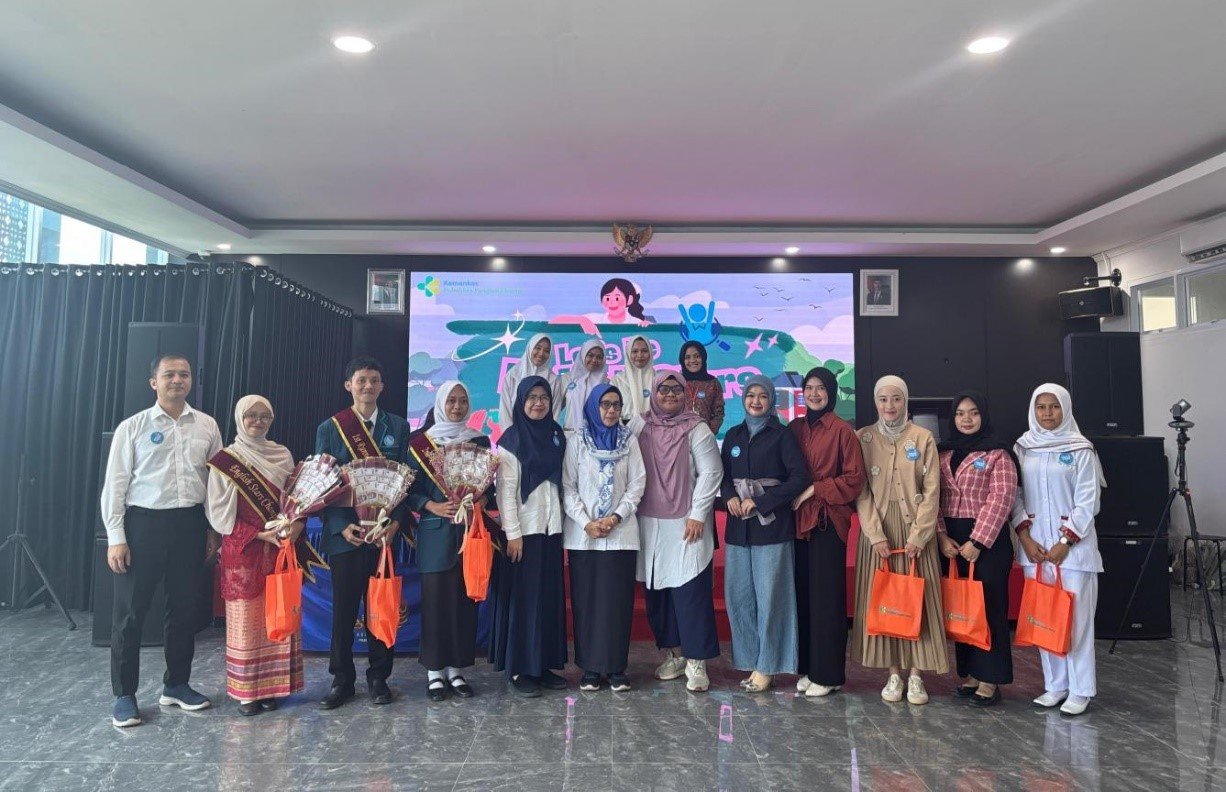
Minat mahasiswa dalam menggunakan Bahasa Inggris di Poltekkes Kemenkes Pangkalpinang masih tergolong rendah, terutama karena kurangnya media dan kegiatan yang dapat menumbuhkan motivasi berbahasa Inggris secara aktif. Kegiatan pengabdian masyarakat ini bertujuan untuk meningkatkan minat dan keberanian mahasiswa dalam berbahasa Inggris melalui program Pemilihan English Star, yaitu kompetisi edukatif yang dirancang untuk menstimulus kemampuan berbahasa inggris mahasiswa. Metode pelaksanaan terdiri atas tahap persiapan konsep kegiatan, sosialisasi kepada mahasiswa, pelaksanaan lomba yang melibatkan berbagai kategori, serta evaluasi minat sebelum dan sesudah kegiatan. Sebanyak 16 mahasiswa dari berbagai program studi yang terlibat aktif dalam kegiatan ini. Hasil kegiatan menunjukkan adanya peningkatan minat dan kepercayaan diri mahasiswa dalam menggunakan Bahasa Inggris, yang ditunjukkan melalui minat mahasiswa mengikuti kegiatan pemilihan English Star. Mahasiswa juga menunjukkan antusiasme tinggi selama kompetisi, dan muncul role model baru di kalangan mahasiswa melalui penobatan English Star. Kegiatan ini membuktikan bahwa pendekatan berbasis kompetisi yang menyenangkan dan aplikatif mampu meningkatkan motivasi serta penggunaan Bahasa Inggris di lingkungan kampus.
Downloads
References
Chang, P., Zhou, L., & Zhang, L. J. (2024). The roles of task-specific self-efficacy and enjoyment in EFL learners’ development of speaking CALF: A longitudinal study. System, 127, 103539. https://doi.org/10.1016/j.system.2024.103539
Deci, E. L., & Ryan, R. M. (2000). The “what” and “why” of goal pursuits: Human needs and the self-determination of behavior. Psychological Inquiry, 11(4), 227–268. https://doi.org/10.1207/S15327965PLI1104_01
Fan, X. (2022). The development of EFL learners’ willingness to communicate and self-efficacy: The role of flipped learning approach with social media. Frontiers in Psychology, 13, 1001283. https://doi.org/10.3389/fpsyg.2022.1001283
Matsumoto, M., & Obana, M. (2023). English language proficiency and professional development in healthcare education: A systematic review. Nurse Education Today, 126, 105776. https://doi.org/10.1016/j.nedt.2023.105776
Omar, S. F. et al. (2020). Interactive language learning activities for learners’ communicative ability. International Journal of Educational Research Review, 9(4), 1010-1016. https://doi.org/10.11591/ijere.v9i4.20605
Pan, Y. (2025). Global healthcare communication: innovating medical English education. Cogent Education, 12(1), 2482505. https://doi.org/10.1080/2331186X.2025.2482505.
Richards, J. C. (2017). Curriculum development in language teaching. Cambridge University Press.
Slavin, R. E. (2019). Educational psychology: Theory and practice (13th ed.). Pearson.
Wang, Y., & Chen, L. (2020). Competitive learning strategies and their effects on learners’ motivation in EFL classrooms. Journal of Language Teaching and Research, 11(3), 345–353. https://doi.org/10.17507/jltr.1103.14
Zhang, T. (2024). Effects of self-regulation strategies on EFL learners’ motivation, willingness to communicate, and self-efficacy. BMC Psychology, 12, 75. https://doi.org/10.1186/s40359-024-01567-2
Zhang, T. (2024). Effects of self-regulation strategies on EFL learners’ language learning motivation, willingness to communicate, and self-efficacy. BMC Psychology, 12, 75. https://doi.org/10.1186/s40359-024-01567-2
Downloads
Published
Issue
Section
License
Copyright (c) 2025 Nurma Zela Gustina, Arif Rahman Aceh, Erni Chaerani (Author)

This work is licensed under a Creative Commons Attribution-ShareAlike 4.0 International License.
In submitting the manuscript to the journal, the authors certify that:
- They are authorized by their co-authors to enter into these arrangements.
- The work described has not been formally published before, except in the form of an abstract or as part of a published lecture, review, thesis, or overlay journal.
- That it is not under consideration for publication elsewhere,
- That its publication has been approved by all the author(s) and by the responsible authorities – tacitly or explicitly – of the institutes where the work has been carried out.
- They secure the right to reproduce any material that has already been published or copyrighted elsewhere.
- They agree to the following license and copyright agreement.
License and Copyright Agreement
Authors who publish with Kareba: Jurnal Pengabdian Masyarakat agree to the following terms:
- Authors retain copyright and grant the journal right of first publication with the work simultaneously licensed under Creative Commons Attribution License (CC BY-SA 4.0) that allows others to share the work with an acknowledgment of the work's authorship and initial publication in this journal.
- Authors can enter into separate, additional contractual arrangements for the non-exclusive distribution of the journal's published version of the work (e.g., post it to an institutional repository or publish it in a book), with an acknowledgment of its initial publication in this journal.
- Authors are permitted and encouraged to post their work online (e.g., in institutional repositories or on their website) before and during the submission process, as it can lead to productive exchanges, as well as earlier and greater citation of published work.